National Hispanic Heritage Month runs from September 15 to October 15 each year. Schools use it to honor the histories, cultures, and contributions of Americans with roots in Spain, Mexico, the Caribbean, and Central and South America. For teachers, the month raises a bigger question than what to put on a bulletin board. It asks what students actually see when they look at the people, books, and history we choose to teach.
There’s a simple way to think about this.
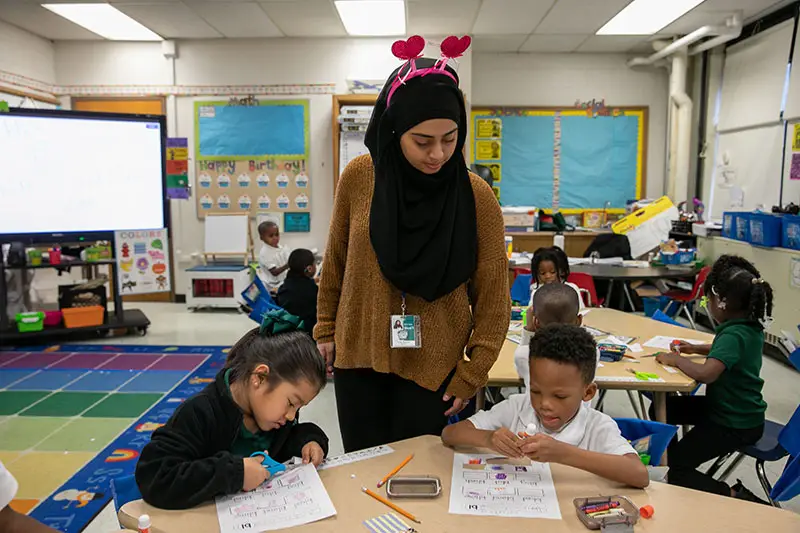
Good classrooms work like mirrors. They reflect a student’s own identity, family, and community back at them, so they feel recognized in what they’re learning. Good classrooms also work like telescopes. They introduce students to people, careers, and futures they haven’t pictured for themselves yet, and stretch what they think is possible. Hispanic Heritage Month gives teachers a natural opening to build both, but only if the month goes deeper than a themed display.
At City Teaching Alliance, this idea sits at the center of how we prepare teachers. Strong instruction depends on knowing your students well enough to build a classroom that reflects who they are and expands what they can imagine for their futures.
Why Hispanic Heritage Month Matters for Teachers
The numbers explain why this work carries weight. Latino students now account for roughly 28% of public school enrollment nationwide, the largest group of students of color in the country. Hispanic and Latino teachers, by comparison, make up only about 9% of the teaching workforce.
Researchers at the Urban Institute studied Texas classrooms and found that Latino elementary students who had at least one Latino teacher had stronger academic achievement, better classroom behavior, and higher rates of high school graduation.
That gap means the majority of Latino students will move through their entire K-12 education without a teacher who shares their background. It puts real weight on what every teacher, regardless of their own identity, chooses to include in the curriculum during Hispanic Heritage Month and throughout the year. Representation in daily instruction is one lever every teacher can pull.
Hispanic Heritage Month Books and Historical Figures by Grade Level
A generalized “explore Hispanic culture” unit rarely sticks with students. Specific books and specific people do. Here are options organized by grade band that give teachers a starting point or both the mirror and the telescope.
Elementary school
- Alma and How She Got Her Name, by Juana Martínez-Neal, and Drum Dream Girl by Margarita Engle both work well as read-alouds about identity and family history.
- Dreamers, by Yuyi Morales, tells the story of a mother and son discovering a public library after immigrating to the United States.
- Sonia Sotomayor’s own picture-book memoir, Turning Pages, gives younger students a real example of perseverance from a sitting Supreme Court justice.
Middle school
- Esperanza Rising, by Pam Muñoz Ryan, pairs naturally with a lesson on the Bracero Program and twentieth-century labor migration.
- Dolores Huerta and the United Farm Workers movement connect directly to a civics unit on organizing and workers’ rights.
- Roberto Clemente is worth teaching beyond his career statistics: he died in a 1972 plane crash while delivering earthquake relief supplies to Nicaragua, a detail that turns a sports lesson into one about civic responsibility.
High school
- The House on Mango Street, by Sandra Cisneros, and the poetry of Pablo Neruda both offer strong material for a unit on voice and identity in literature.
- Ellen Ochoa, the first Hispanic woman to travel to space, gives STEM classrooms a direct tie to NASA history.
- Sonia Sotomayor’s Supreme Court opinions work as real primary sources for a government or law class.
Hispanic Heritage Month Classroom Activities Beyond the Bulletin Board
The activities students remember tend to be personal, not just historical:
- A family story project asks students to interview a relative about a tradition, a recipe, or a memory, then share it with the class.
- A map activity has students mark where their families are from and research one fact about that place.
- Inviting a Latino parent, staff member, or local professional to speak with the class gives students a direct look at a career path they may not have considered, a telescope in the truest sense.
- Pairing a historical figure with a present-day counterpart in the same field, a working Latina engineer alongside Ellen Ochoa, for example, shows students the line running from history into their own future.
Teaching Hispanic and Latino History Beyond October 15
Heritage months run the risk of disappearing the day after they end. A few habits keep that from happening. Keep two or three of the books listed above in the regular classroom library rather than pulling them for a September display and putting them away. When labor history, civil rights, or immigration comes up later in the year, return to the same figures introduced during Hispanic Heritage Month instead of starting over with new ones. Keep a running list of Latino scientists, authors, and historical figures to reference across subjects all year, not only during social studies.
Hispanic and Latino history is American history. Treating it as a single unit each fall shortchanges both the subject and the students learning it.
Frequently Asked Questions About Hispanic Heritage Month
Q: When is Hispanic Heritage Month?
A: Hispanic Heritage Month runs every year from September 15 to October 15. The dates fall in the middle of two months rather than lining up with a single calendar month because September 15 marks the independence anniversary of five Latin American countries: Costa Rica, El Salvador, Guatemala, Honduras, and Nicaragua. Mexico and Chile’s independence days follow shortly after, on September 16 and September 18.
Q: Why do schools celebrate Hispanic Heritage Month?
A: Schools observe the month to recognize the history, culture, and contributions of Hispanic and Latino communities in the United States, and to make sure students see that history reflected in what they learn. Given how few Hispanic and Latino teachers are currently in classrooms relative to the number of Hispanic and Latino students, the month also serves as a prompt for every teacher to build in that representation deliberately.
Q: What grade levels should teach Hispanic Heritage Month lessons?
A: All of them. The specific books, historical figures, and activities should shift by grade band, but Hispanic and Latino history has entry points for elementary read-alouds, middle school civics and history units, and high school literature, government, and STEM classes alike.
Q: How can teachers celebrate Hispanic Heritage Month without a Hispanic or Latino background themselves?
A: By treating it the same way they would any other unit worth teaching well: choosing specific, well-researched material, asking students genuine questions about their own families and traditions, and being honest about what they don’t already know. Representation in the curriculum doesn’t require a teacher to share a student’s identity. It requires intention.
The Broader Responsibility
Every teacher carries a responsibility to build a classroom that works as both a mirror and a telescope: one that reflects the world students already know and helps them see further than they thought possible. Hispanic Heritage Month is one clear chance to put that into practice. What happens for the rest of the school year determines whether it was more than symbolic.
At City Teaching Alliance, we train teachers to build that kind of classroom every day, one where students recognize themselves in what they learn and leave able to imagine more for themselves because of it.